

Introduction
Socket Weld Fitting is one of the common and standard methods in the industry for connecting different parts to each other. There is also a type of flange called Socket Weld Flange which is used in many industries for connecting pipes. In this article, we will comprehensively examine topics such as standards related to socket weld fitting, its types, applications, advantages and disadvantages and finally the difference between socket weld fitting and socket weld flange.
Enter the AzinForge products page
| Contact number | |
|---|---|
| +9858-37217753-5 | sales@azinforge.com |
Last updated: 11/19/2025 | Approximate reading time: 7 minutes
What you read in this article:
What is a Socket Weld Connection?
Socket welds are a common and reliable method of joining metal parts in pressurized systems. In this method, a male part (such as a pipe) is inserted into the female part of another part and then the two parts are permanently joined together by applying heat and fusion welding.
Socket weld standards are developed by internationally recognized organizations such as the American Welding Society (AWS) and the European Standards Organization (EN). These standards specify requirements for design, dimensions, welding procedures, quality control, and inspection to ensure the performance and safety of the connection.
Some of the most important standards used in the design and manufacture of socket weld fittings are:
ASME B16.11 – Standard for Forged Fittings Including Socket Weld and Threaded Types
MSS SP-97 – Technical Specifications for Branch Fittings such as Weldolet, Sockolet, etc.
ANSI/ASME B31.1 and B31.3 – Standards for Power Plant and Process Piping Systems
ASTM A105 – Standard for Forged Steel Materials Used in High Pressure Flanges and Fittings
What is a socket weld flange? | Features
Types of socket weld fittings
Socket Weld Fitting is one of the most widely used methods in the piping and fluid transfer industries, used to connect pipes to each other or to industrial equipment. This type of connection is used in various industries, including oil and gas, petrochemical, power plants, and chemical industries, due to its features such as high pressure resistance, high mechanical strength, and no need for soldering.
Socket weld fittings are usually made of forged steel and are tapered in design to provide a tight, leak-free connection when the pipe is placed inside the socket.
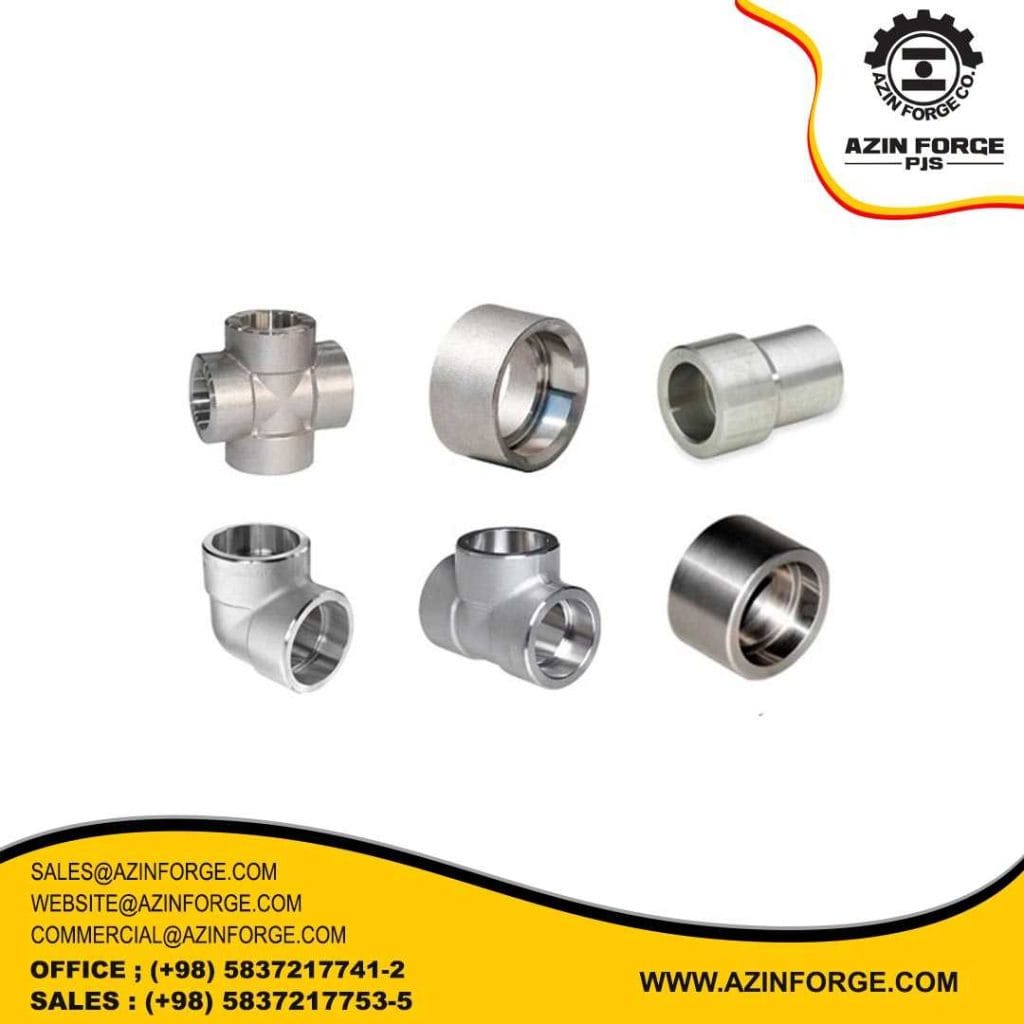
Some of the most commonly used types of socket weld fittings are:
1. Socket Weld Tee
This fitting is used to connect three pipes of the same diameter and is responsible for dividing or combining the flow of fluid. This type of fitting is widely used in the oil and gas, petrochemical and power plant industries.
2. Socket Weld Coupling
A socket weld coupling is used to connect two pipes of the same diameter and is one of the most common types of fittings in pressurized systems. This type of fitting is commonly used in process, steam and hydraulic pipelines.
3. Socket Weld Nipple
A socket weld nipple is used to directly connect two pipes or to connect to equipment. This type of connection is usually used in confined spaces or in systems that require a quick connection.
4. Socket Weld Reducing Coupling
This type of connection is used to connect two pipes with different diameters. Nipple couplings are used when there is a need to change the size in the piping route.
5. Socket Weld Elbow
A socket weld elbow is used to change the direction of the pipe route at different angles, usually 90 degrees or 45 degrees. This type of connection is very common in pressurized fluid transmission systems.
Flange | Types | Specifications | Dimensions
Application of socket weld connection
Socket Weld Fittings are widely used in various industries due to their characteristics such as high strength, resistance to pressure and heat, and permanent and leak-free connection. The following are the most important fields of application for this type of joint:
1. Oil and gas industry
In the oil and gas industry, socket weld fittings are used to connect pipes, valves, and equipment under pressure. This method is considered an ideal option for transmission lines and refinery processes due to its high resistance to severe working pressures, temperature changes, and corrosive environments.
2. Automotive industry
In the automotive industry, socket weld connections are used to connect metal parts of different thicknesses. This type of joint is used in the manufacture of light and heavy vehicles and industrial machinery due to its high mechanical strength and durability against vibration and metal fatigue.
3. Construction Industry
In the construction sector, socket weld joints are used to connect metal parts in steel and concrete structures. The resistance of this type of joint to bending forces, vibrations and environmental pressures makes it a suitable option for metal skeletons, bridges and heavy structures.
4. Aerospace Industry
In the aerospace industry, socket weld fittings are used in the manufacture and repair of metal parts of aircraft, spacecraft and satellites. This method is of particular importance due to its precise connection, low weight, and high resistance to mechanical stresses and harsh environmental conditions.
5. Marine Industry
In the marine industry, this type of joint is used in the manufacture and repair of ships, submarines and offshore structures. The high resistance of socket weld joints to water pressure, salt corrosion and extreme temperature changes makes it perform stably and safely in harsh marine conditions.
What is forging? Types of it
The difference between a socket weld connection and a socket weld flange
Socket Weld Fitting is a welding method in which pipes are joined together using molten metal and an electrode. This method is typically used for small to medium diameter metal pipes. In this type of joint, the end of the pipe is inserted into the socket of the other component, and then a strong and permanent bond is created by welding around the joint.
On the other hand, a Socket Weld Flange is a flange connection in which the pipe is welded to the flange using the socket weld method, and then the flange is connected to its matching flange in the piping system through bolts and nuts. Flanges usually have a circular plate with evenly spaced bolt holes, allowing for quick assembly and disassembly of the connection.
Therefore, the main difference between these two types of connections lies in the method and type of joint:
In a socket weld fitting, pipes are directly and permanently welded to each other.
In a socket weld flange, the pipe is first welded to the flange, and then connected to other parts of the system using bolts and nuts, creating a non-permanent but strong connection.
In summary, socket weld fittings are suitable for permanent and high-pressure joints, while socket weld flanges are a better option for systems that require disassembly, repair, or periodic maintenance.
Advantages and disadvantages
Socket weld fittings, like other metal joining methods, have their own advantages and disadvantages, and understanding them is crucial when selecting the appropriate method for industrial projects.
Advantages of Socket Weld Fittings
High strength and durability: This type of joint offers excellent resistance to pressure, vibration, and thermal changes due to full welding around the connection area.
Reduced stress and deformation: The socket weld process provides more uniform heat distribution, which helps reduce the likelihood of deformation or warping of the pipes.
Suitable for pipes with different thicknesses: This method allows the connection of components with varied wall thicknesses, offering high flexibility in design.
Leak-proof connection: Because it creates a complete metal-to-metal bond, this type of joint is fully leak-resistant and widely used in high-pressure systems.
Disadvantages of Socket Weld fittings
Requires skilled labor and specialized equipment: Proper execution of this method demands experience, high precision, and standard welding equipment.
Higher cost and longer installation time: Preparation, alignment, and welding operations can be more time-consuming and expensive compared to other methods.
Limitation on pipe size: This method is generally suitable for small to medium pipe diameters (up to about 2 inches) and is not cost-effective for larger sizes.
Conclusion
Socket weld fitting (Socket Weld Fitting) is one of the standard and widely used methods in piping and high-pressure systems. This type of joint creates a strong, leak-proof, and pressure- and heat-resistant connection by welding at the point where the pipe meets the socket.
Due to features such as high mechanical strength, durability in harsh environmental conditions, and long-term reliability, socket welds are widely used in the oil and gas industry, petrochemical plants, power plants, chemical industries, and construction sectors.
However, choosing this method should be done by considering the type of fluid, operating pressure, pipe diameter, cost, and skill of the workforce. Overall, socket weld is a suitable option for systems that require a permanent, strong, and safe connection, and it plays an important role in increasing the service life and efficiency of industrial piping networks.
Follow AzinForge on LinkedIn and get access to our latest developments and projects in the field of forging and industrial design. Do not miss this opportunity and connect with us on this social network.